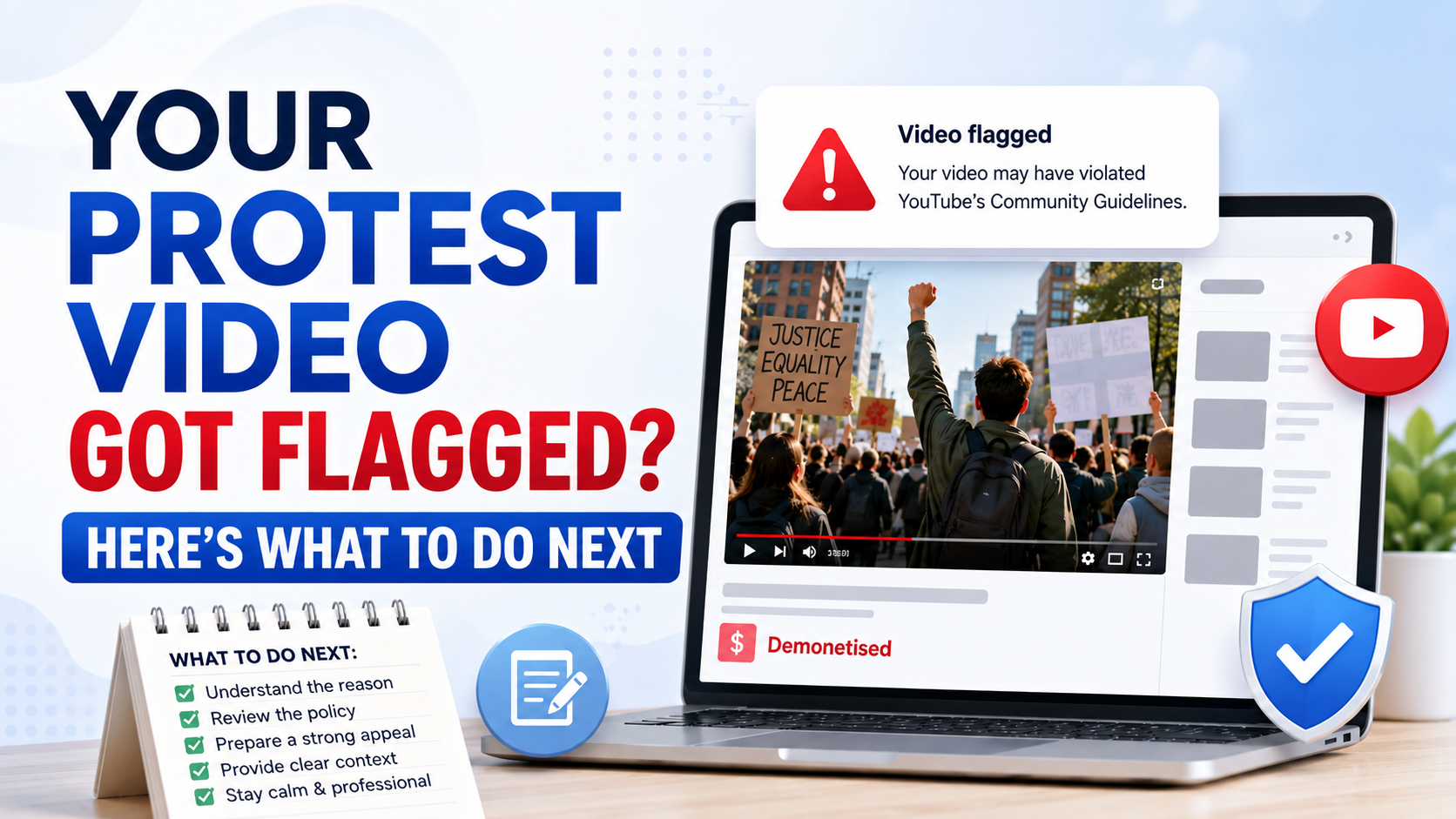

Getting Flagged Is Not Proof You Did Something Wrong. It Is Proof the Subject Was
Sensitive Enough to Trigger Review.
Even creators who follow every guideline in this series can still end up demonetized, restricted,
or taken down. That is not a reflection of a bad video — it is simply how platforms handle this
category of content. What matters now is understanding exactly what has happened to your
video, because the correct response is different depending on which of these you are actually
dealing with.
First, Know Exactly What Happened to You
A demonetization notice means the video stays up and visible, but ad revenue is switched off
This is the mildest outcome and the one platforms apply most liberally to anything touching unrest or civil disorder. An age-restriction or limited state means the video stays up but loses reach, showing to fewer people through search and recommendations. A strike means the video has been removed entirely and the removal counts against your channel’s standing, with enough strikes eventually threatening the channel itself. A takedown driven by a legal request or court order is a different category altogether, and often cannot be contested through the platform’s normal appeal process at all. Knowing which of these you are facing decides what you do next treating a strike like a simple demonetization dispute, or vice versa, wastes the response that would have actually worked.
Read the Actual Policy Line Cited, Not the Label
Platforms rarely write “this is political” as a reason. They cite a specific line graphic content, hate speech, misinformation, harassment, community guidelines around sensitive events — and your appeal has to speak directly to that specific line, not to a general defense of your right to cover the story. An appeal that argues “this was important journalism” without addressing the actual policy cited is one of the most common reasons a first appeal fails.
Do Not Appeal in the First Hour
The instinct is to hit appeal immediately, while frustrated. Resist it. Pull your raw footage first, check the exact timestamp the platform is objecting to if that information is given, and put together a short, specific explanation of what that moment shows and why it does not violate the cited policy. A considered appeal submitted a few hours later almost always performs better than an emotional one submitted in the first ten minutes.
Your First Appeal Is Usually Your Best Shot
Most platforms allow a limited number of appeals per decision, and once you have used them, further review becomes harder to get, sometimes requiring escalation through entirely different channels. Treat the first appeal as the one that has to count: specific, evidence-backed, and addressed to the exact policy line rather than a quick “please look at this again” that burns your best opportunity on a weak submission.
Know When It Is Bigger Than One Video
Repeated strikes on unrelated videos can put the entire channel at risk of termination, and that is a fundamentally different situation from a single flagged upload. Legal takedowns tied to a court order or government request also do not follow the same appeals path as a community guidelines strike the video may not come back through the platform at all, regardless of how well-documented your case is. Identifying which situation you are actually in, early, saves time you would otherwise spend appealing something that was never going to be resolved that way.
When to Bring In Outside Help
For a single demonetization or restriction, a well-written appeal you submit yourself is usually enough. For repeated strikes, a full channel termination, or anything involving a legal takedown, professional escalation genuinely changes the odds but it is worth knowing upfront that even structured escalation does not guarantee a reversal, particularly for full channel terminations, where realistic success rates can be modest depending on the platform and the history involved. What it does reliably improve is the quality of the case being presented: proper documentation, the right escalation contacts, and a submission that speaks the platform’s own policy language back to it.
This is the exact work Ping Network’s Advocacy team does for creators and rights holders every week, not as a guaranteed fix, but as the difference between a case that gets a fair review and one that gets lost in a queue. If you are dealing with a strike, a termination, or a takedown you believe was handled unfairly, that is precisely the conversation worth having with us before you assume the channel is gone for good.